ETIAS And Schengen Rules For A 14 Day Europe Trip
Entry rules are the one part of a Europe trip that no tour operator can fix for you at the desk. The good news for anyone booking a 12 to 16 day package is that most of the scary headlines do not apply yet, and the ones that do apply are simple to satisfy if you know which document is being asked for and by whom.

Short answer
ETIAS is not in operation and no applications are being collected, so nothing is required from you now. The EU expects it in the last quarter of 2026. A 14 day tour uses 14 of the 90 days Schengen allows in any 180, and US, Canadian, Australian and British passport holders need no visa. Your passport needs three months validity beyond departure by law, six months beyond return by most operator contracts.
ETIAS And Schengen Rules For A 14 Day Europe Trip
Entry paperwork is the least exciting part of planning a Europe tour, and it is also the part where outdated advice does real damage. Half the articles ranking for entry rules still describe a system that has not started, or call one operational that finished rolling out months ago. This guide separates what is law today, what an operator's contract adds on top, and what is simply not live yet, using the official sources throughout.
Across the 21 packages listed on this site, itineraries cross between 2 and 10 countries, and several of them dip in and out of the Schengen area more than once. That matters, because the rules change at each external border. A western classics loop and a Balkans loop face genuinely different paperwork, even though both are sold as 14 day Europe tours.
Do You Need ETIAS For A Europe Tour Right Now?
No. ETIAS is not in operation and no applications are being collected, so there is nothing to apply for and nothing a border officer can ask you for on a trip booked today. The EU's own site states this plainly, and adds that the European Union will announce the specific start date several months before launch. Any page selling you an ETIAS application form is charging for a service that does not exist yet.
That last sentence is worth dwelling on, because copycat sites are the reason this question causes so much confusion. The EU itself warns that there is only one official ETIAS website, europa.eu, and that applying directly will cost EUR 20, with any additional fee going to an intermediary. When the system does go live, an application will cost EUR 20, with under 18s, over 70s and qualifying family members of EU, EEA or Swiss nationals exempt, and the fee is non-refundable.
The timeline the EU has committed to is deliberately loose. the revised implementation timeline says ETIAS is expected in the last quarter of 2026, and that the specific date will be announced later by the European Commission. Do not build a trip around a month, and do not trust any page that names a day.
There is also a soft landing built into the launch. When ETIAS starts, a transitional period of at least six months means travellers should apply but will not be refused entry without one, provided they meet the remaining entry conditions. A further grace period of at least six months follows, with a narrow exception for first-time arrivals. So even the first travellers affected by the rule get a year of cushioning.
For a two week tour booked now, the practical answer is simple: check your passport, check your operator's booking conditions, and ignore anyone selling you an ETIAS form. If you are travelling later and want the detail, our companion piece on 14 Days Europe Tour Packages keeps the roster current, and the blog answer on ETIAS for Americans covers the US-specific angle.

What Is ETIAS And Who Will It Apply To?
ETIAS is a planned electronic travel authorisation for nationals of 59 visa-exempt countries and territories, covering short stays of up to 90 days in any 180 across 30 European countries. It will apply to US, Canadian, Australian and British passport holders once live, because those passports are visa-exempt today. It costs EUR 20, is linked to one passport, and is valid for up to three years or until that passport expires.
The country count is where most summaries slip, so it is worth being precise. ETIAS will cover 30 European countries, while the Schengen area has 29 members. The difference is Cyprus, which is an ETIAS country but not a Schengen country: internal border controls there have not yet been abolished by the Council. Cyprus also stamps passports manually, and time spent there is calculated separately from the 90-day allowance in the other ETIAS countries.
| ETIAS fact | Official position |
|---|---|
| Status | Not in operation, no applications collected |
| Expected start | Last quarter of 2026, no specific date announced |
| Fee | EUR 20, non-refundable |
| Exemptions | Under 18s, over 70s, qualifying family members of EU/EEA/Swiss nationals |
| Validity | Up to three years, or until the linked passport expires |
| Coverage | 59 visa-exempt nationalities, 30 European countries |
| Processing once live | Most within minutes, up to four days, longer if extra information is requested |
Note the validity wording. An authorisation lasts up to three years or until the passport it is linked to expires, whichever comes first, and a new passport means a new ETIAS. Writing "valid for three years" flat is wrong, and it is one of the most repeated errors on entry-rule pages.
Processing promises are forward-looking because the system is not live, but the EU has published how it will work: most applications processed within minutes, a decision within four days if it takes longer, extendable by up to 14 days if additional documentation is requested, or 30 days if an interview is needed. None of that applies to a 2026 booking yet.
If your trip is still a plan rather than a booking, the choice of itinerary matters more than any authorisation. The three packages below are the ones readers comparing entry-heavy itineraries look at first: a western classics loop, a same-family alternative with a different start city, and a longer Balkans route that crosses more external borders.
The Balkans option in that band is the interesting one from an entry-rules point of view, because it threads through Serbia, Bosnia and Herzegovina, Montenegro, Albania and North Macedonia, none of which are Schengen, while touching Croatia, which is. That border pattern has consequences the next two sections explain.
How Does The Schengen 90/180 Rule Work On A 14 Day Tour?
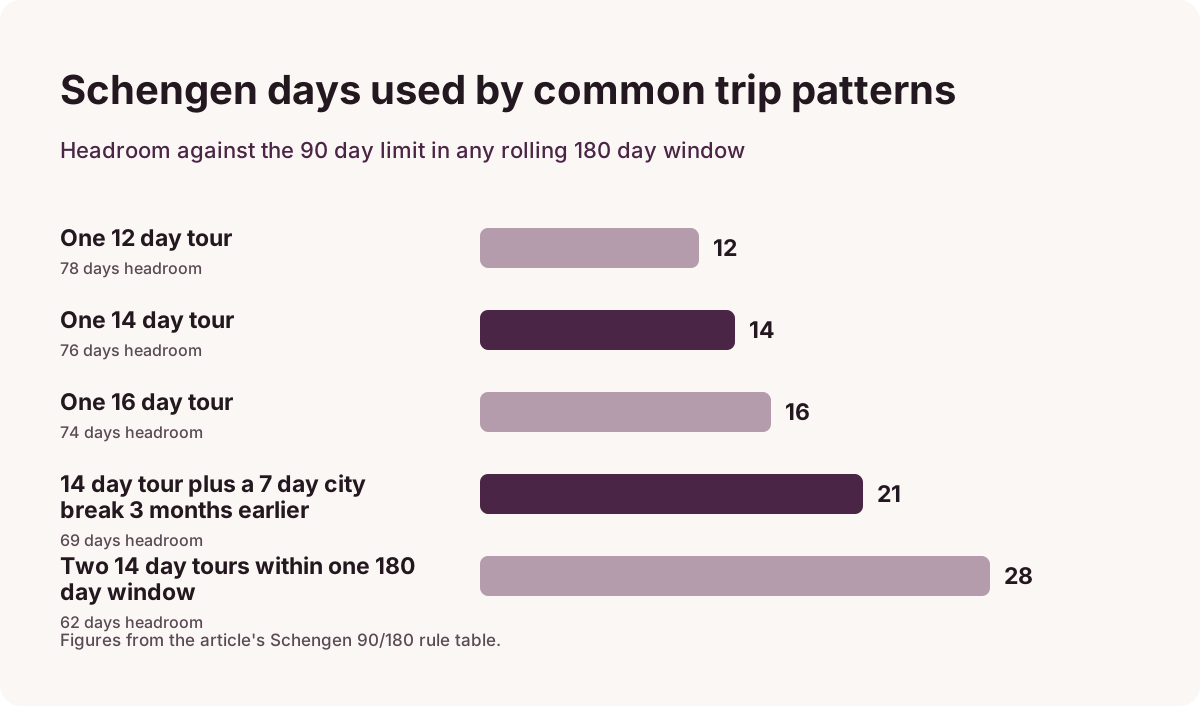
The rule allows no more than 90 days of presence inside any rolling 180 day window, counted backwards from each day of stay. A 14 day tour uses 14 of those 90 days, leaving roughly 76 spare, so the arithmetic only matters if you have already spent time in Schengen countries in the previous six months. The date of entry counts as day one and the date of exit as the last day.
The rolling window is the part people misread. It is not a calendar reset or a "wait 90 days before returning" rule. Each day you are present, the count looks back 180 days and totals your presence. A two week tour barely dents the allowance. The travellers who need to do sums are those stacking a spring trip, a summer tour and an autumn city break inside the same window, because the FCDO notes that visits to Schengen countries in the 180 days before you travel count towards your 90 days.
The legal source is Article 6 of the Schengen Borders Code, which sets out the entry conditions for short stays. The same article sets the passport validity rules covered later in this guide. Overstaying is not a technicality: the FCDO states that if you overstay the 90-day visa-free limit, you may be banned from entering Schengen countries for up to three years.
| Trip pattern | Schengen days used | Headroom against the 90 day limit |
|---|---|---|
| One 12 day tour | 12 | 78 days |
| One 14 day tour | 14 | 76 days |
| One 16 day tour | 16 | 74 days |
| 14 day tour plus a 7 day city break 3 months earlier | 21 | 69 days |
| Two 14 day tours within one 180 day window | 28 | 62 days |
US, Canadian, Australian and British passport holders need no visa for any of this. All four are named in Annex II of the EU's visa regulation, which lists countries whose nationals are exempt from the visa requirement for stays of no more than 90 days in any 180 day period. The tour itself needs no special authorisation beyond that, today.
For most readers the 90/180 rule is a non-event, and that is worth saying loudly because fear of it puts people off booking. The packages that make the arithmetic interesting are the long ones, and the guide to how 14 days splits across countries shows how little of any two week itinerary is actually spent inside Schengen borders when the route includes the Balkans or Britain.
Which Countries On A Europe Itinerary Are Outside Schengen?
The United Kingdom, Ireland, Serbia, Bosnia and Herzegovina, Montenegro, Albania, North Macedonia and Kosovo are all outside Schengen, and days spent there do not consume the 90 day allowance. Croatia, Bulgaria and Romania are inside, having been joined by Bulgaria and Romania on 1 January 2025. Cyprus participates in Schengen cooperation but its internal border controls have not been abolished, so it is not a Schengen country.
That list is not trivia, it changes the shape of your trip. A Balkans loop that dips in and out of Croatia crosses an external Schengen border each time, which means EES registration can happen more than once on a single tour. A Britain and Ireland tour never enters Schengen at all, so the 90/180 rule and the three-month passport validity rule simply do not apply to it, though the UK's own ETA scheme does.
| Country on these itineraries | In Schengen? | What it means for your paperwork |
|---|---|---|
| Croatia | Yes | Counts towards 90/180, EES at the border |
| Bulgaria | Yes, since 1 January 2025 | Counts towards 90/180 |
| Romania | Yes, since 1 January 2025 | Counts towards 90/180 |
| United Kingdom | No | UK ETA rules apply instead, no Schengen count |
| Ireland | No, opt-out | Own visa and border policies |
| Serbia | No | Days do not consume the Schengen allowance |
| Bosnia and Herzegovina | No | Days do not consume the Schengen allowance |
| Montenegro | No | Days do not consume the Schengen allowance |
| Albania | No | Days do not consume the Schengen allowance |
| North Macedonia | No | Days do not consume the Schengen allowance |
The official list of the 29 Schengen countries, 25 EU members plus Iceland, Norway, Switzerland and Liechtenstein, is published by the European Commission's home affairs department, and it is the page to check if your itinerary includes somewhere unusual. The most common error on competitor pages is still listing Croatia as outside Schengen, which was true years ago and is wrong now.
For choosing between packages, the split matters in a second way. The western classics on this site, eight of the 21 packages, stay almost entirely inside Schengen, which means one border entry, one EES registration, one set of rules. The Balkans and Adriatic group, five packages, crosses external borders repeatedly. Neither is a problem, but they reward different levels of paperwork awareness, and the guide to multi-country packages breaks down which itinerary reaches which countries.
The Classic Europe package that box points to is a 14 day London round trip rated 4.6 across 309 reviews, from $3,185 per person, and its London start is exactly why the UK ETA section below exists. It is a good example of a tour that touches three separate entry regimes in one fortnight: the UK, the Schengen area, and nothing else, but the UK leg still catches people out.
What Does The EES Mean At The Border?
The Entry/Exit System started on 12 October 2025 and has been fully operational at every external border crossing point of the participating countries since 10 April 2026, when manual passport stamping for short stays ended. On first entry, an officer records your passport details and takes a photo and fingerprints. On later crossings, they only verify what is already recorded, which takes less time.
EES is the rule that is live now, and it is the one that has actually changed the border experience for non-EU travellers. There is no cost to register, and the UK government notes that a digital EES record is valid for three years. Children aged 11 or younger do not have their fingerprints scanned but can be required to have a photo taken. You do not need to do anything before arrival, but the FCDO advises being prepared to wait longer than usual at the border.
The system applies to both visa-required and visa-exempt travellers, and it changes nothing about the rules on how long you can stay: those remain 90 days in any 180, harmonised in the Schengen Borders Code. What it replaces is the passport stamp, which used to be the only record of your entries and exits. Now the record is digital, and the automated overstay calculator runs off it.
For a 14 day tour, the practical points are three. First, your first Schengen crossing of the trip takes longer than it used to, so build slack into any self-arranged connection on arrival day. Second, a Balkans itinerary that enters and exits Schengen more than once will register more than once, though repeat registrations are faster because your biometrics are already on file. Third, Ireland and Cyprus still stamp passports manually despite being EU members.
The one thing not to write is that EES is still phasing in. Some government advice pages use looser wording, but the EU's own position is unambiguous: fully operational at all external border crossing points since 10 April 2026. A tour departing this autumn will meet the finished system, not a trial.

What Passport Validity Do You Need For A 14 Day Europe Tour?
Schengen law requires a passport valid for at least three months after your intended departure from the area, and issued within the previous ten years. Both are legal grounds for refusal. But two operators on this roster, Contiki and Intrepid, contractually require six months of validity beyond the trip return date, so six months is the number that actually keeps you safe on a package tour.
The gap between law and contract is the single most useful thing to understand here, and it is why the dedicated passport validity guide is worth a read before you book. You can hold a passport that satisfies the Schengen Borders Code perfectly and still be refused by your tour operator, because their booking conditions are a contract you agreed to, not a border law.
| Requirement | Who asks | The number |
|---|---|---|
| Validity beyond departure from Schengen | Schengen law | At least 3 months |
| Issued within the previous | Schengen law | 10 years |
| Validity after trip return date | Contiki booking conditions | 6 months, machine-readable |
| Validity after last date of travel | Intrepid booking conditions | 6 months |
| Passport validity after return | Expat Explore | No number set, duty on the traveller |
The ten-year rule catches British passport holders specifically. The FCDO warns that passports renewed before 1 October 2018 may have a date of issue more than ten years ago, making them invalid for entry to the Schengen area even if the expiry date looks fine. The extra months that used to be carried over on renewal do not help you here, because the issue date is what counts.
US readers get the three-month-beyond-departure rule from the State Department's own Europe guidance, but the ten-year half of the rule is not in that guidance, so treat the Schengen Borders Code as the source for it. The safe summary for any passport: issued less than ten years ago, and six months of validity past your return date, which clears both the law and every operator contract on this site.
Do You Need Travel Insurance To Enter Europe?
No. Travel insurance is not a legal condition of entry for visa-free visitors to the Schengen area, because it is absent from the exhaustive list of entry conditions in Article 6 of the Schengen Borders Code. It is a legal condition of a Schengen visa application, which US, Canadian, Australian and British passport holders do not make for a short stay. But your tour operator's contract is a separate question, and there the answer varies by company.
This is the distinction most pages flatten, and the roster on this site makes it concrete. Intrepid makes insurance mandatory, with a recommended minimum of US$200,000 per category of cover and proof demanded on day one. Expat Explore makes it a condition of booking: their terms state that if you cannot provide proof of adequate travel insurance prior to the start of your tour, you will not be permitted to embark on day one. G Adventures requires medical travel insurance including at least USD 200,000 of emergency evacuation and repatriation cover on all tours. Contiki only recommends it, in identical wording across all four regional booking conditions, and does not require it.
| Operator | Insurance position | What their own terms say |
|---|---|---|
| Intrepid Travel | Mandatory | US$200,000 recommended minimum per category, policy number needed on day one |
| Expat Explore | Condition of booking | Proof required before day one or you cannot embark |
| G Adventures | Mandatory | At least USD 200,000 evacuation and repatriation cover, proof on day one |
| Contiki | Highly recommended, not required | Identical wording in all four regional booking conditions |
So the honest sequence for a tour buyer is: check the law, which asks for nothing, then check your operator, which may ask for a lot. The border adds a small footnote: border guards in France and Italy may ask a visa-free arrival to show proof of travel insurance, alongside proof of accommodation, sufficient means and a return ticket. It is not an entry condition, but it is a document an individual officer can request.
The travel insurance guide for escorted tours walks through the operator-by-operator detail, including what counts as adequate cover and when to buy it. The short version: buy at or soon after booking, not the week before departure, because cancellation cover is worthless once the cancellation window has passed.
Does A London Leg Need A UK ETA?
Yes, if your itinerary starts or ends in London and you are not a British or Irish passport holder, you need a UK Electronic Travel Authorisation, which costs GBP 20 and covers visits of up to six months. ETIAS does not cover the UK at all. Every traveller needs one, including babies and children, and it is required even when only transiting UK border control on the way elsewhere.
The London round trip is a common format on this site: Classic Europe, Best of UK and Ireland and others all touch Britain. A US, Canadian, Australian or European passport holder on those trips needs the ETA, full stop, and the application is separate from anything European. The UK government's guidance also notes that an ETA does not guarantee entry, which is standard for any authorisation scheme.
The transit point is the one that surprises people. If your package starts in London but you fly into Paris and take the train, no ETA is needed. If you change planes at Heathrow and pass through UK border control, even for two hours, you need one. British and Irish passport holders are exempt, as are people with permission to live, work or study in the UK.
The cost is GBP 20 per person, per application, and children are not exempted. For a family of four on a London-departure tour, that is a real line in the budget, and it sits outside the package price the same way the long-haul flight does. No package on this site includes flights, and none includes authorisation fees either.
The Europe Escape package above is a 12 day Rome round trip rated 4.5 across 878 reviews, from $2,715 per person, and it is the simplest entry story on the roster: one Schengen entry, no UK leg, no external border crossings mid-tour. For a traveller who finds the paperwork discussion above exhausting, that format removes most of it.
How Do Entry Rules Differ Between Western And Balkans Itineraries?
A western classics itinerary stays inside Schengen and usually the UK, so it means one EES registration, one ETA if London is on the route, and one set of validity rules. A Balkans itinerary crosses external Schengen borders repeatedly through Serbia, Bosnia and Herzegovina, Montenegro, Albania and North Macedonia, none of which are Schengen, so days there do not consume the 90 day allowance but each crossing is a separate border event.
Neither pattern is harder, they are just different. The western loop concentrates all its paperwork at the start: sort the ETA if London features, clear EES once, and the rest of the fortnight is internal travel with no border checks at all. The Balkans loop spreads the paperwork out: every entry into Croatia from a non-Schengen neighbour is an external crossing, with registration, verification and occasionally a queue.
There is a planning advantage hiding in the Balkans pattern. Because days in Serbia, Bosnia and Herzegovina, Montenegro, Albania and North Macedonia do not count against the Schengen allowance, a 14 or 16 day Balkans tour can use meaningfully fewer Schengen days than its length suggests. For a traveller stacking multiple Europe trips into one year, that headroom is genuinely useful, and it is a fact almost never mentioned on generic entry-rule pages.
The roster maths makes the choice concrete. Eight of the 21 packages on this site are western classics, five are Balkans and Adriatic, three cover Central and Eastern Europe, three Scandinavia and the Baltics, and two Britain and Ireland. Austria and Germany appear on 11 itineraries each, more than any other countries, while Serbia appears on 5, all of them in the Balkans group.

Best of UK and Ireland, above, is the extreme case in the other direction: 13 days from London, rated 4.7 across 449 reviews, from $3,235 per person, and it never enters Schengen at all. No 90/180 arithmetic, no EES, no three-month passport rule. Just the UK ETA and Ireland's own rules, which are separate again.
Common Questions About ETIAS And Schengen Rules
Do I Need ETIAS For A Europe Tour Right Now?
No. ETIAS is not in operation and no applications are being collected. The EU expects it in the last quarter of 2026 and will announce the specific start date several months before launch. Nothing is required from a traveller booking or taking a tour today.
How Many Days Of My 14 Day Tour Count Against The Schengen Limit?
Only the days physically spent inside the Schengen area count, and Schengen law allows 90 days in any 180. A 14 day tour that stays inside Schengen uses 14 days. Days in the UK, Ireland, Serbia, Bosnia and Herzegovina, Montenegro, Albania or North Macedonia do not consume the allowance at all.
Is Croatia Outside Schengen?
No, Croatia is inside Schengen. Bulgaria and Romania also joined on 1 January 2025, bringing the area to 29 countries. Cyprus is the one often confused with them: it participates in Schengen cooperation but is not a Schengen country, though it is an ETIAS country.
Does My Tour Operator Require Travel Insurance?
It depends on the operator. Intrepid and G Adventures make it mandatory, Expat Explore makes it a condition of booking with proof required before day one, and Contiki only recommends it. Schengen law does not require insurance of visa-free visitors, but your operator's contract can.
How Long Does My Passport Need To Be Valid?
Schengen law requires validity for at least three months after your departure from the area, and issue within the previous ten years. Contiki and Intrepid both contractually require six months of validity beyond the trip return date, so six months past return is the safe number for a package tour.
Do I Need A UK ETA If My Tour Starts In London?
Yes, unless you hold a British or Irish passport or UK residence. The ETA costs GBP 20, covers visits of up to six months, and every traveller needs one including children. It is required even when only transiting UK border control, and ETIAS will never cover the UK.
If entry paperwork is the last box on your list, the three packages below span the range of border situations you will meet: the London round trip with its UK ETA, the Amsterdam alternative that keeps things simple, and the 16 day Balkans route with the most crossings of all.