How Many European Countries Can You Visit In 2 Weeks
The structural question behind every two week Europe itinerary is how the days divide. Across the 21 verified packages on this site, the honest answer ranges from two countries to ten, and the split matters more than the count.
Short answer
Across the 21 verified packages on this site, country counts range from 2 to 10 per trip, and five of them cross exactly 8 countries. Eleven packages run exactly 14 days. The widest itinerary touches 10 countries, the narrowest just 2, and the median price sits at $3,235 per person for the land package.
Two weeks sounds like a long time until you spread it across a map. A traveller who wants Paris, Rome, Amsterdam and a Swiss valley in one trip is not asking for more days, they are asking how the existing days divide. That question, how the fourteen days actually split across countries, is the structural spine of every itinerary on this site, and the answer routes straight to a departure. This guide works through the real numbers: how many countries a two week package can genuinely cover, how the days divide between travel and time on the ground, and where the trade-offs sit.
The 21 verified, currently bookable multi-country packages on 14 Days Europe Tour Packages give a clean dataset for this. Trip lengths run from 12 to 16 days, with 11 of the 21 running exactly 14. Country counts run from 2 at the narrowest to 10 at the widest, and five of the 21 cross exactly 8 countries. Every price below is a land package price in USD per person, and none of the 21 includes the international flight: 19 of the 21 listings put "Flights" in their not-included block, and the other two list no air either. The long-haul ticket is always a separate cost you book yourself.
How Many European Countries Can You Visit In 2 Weeks?
A two week Europe package can genuinely cover eight countries, and several on this roster do exactly that: five of the 21 verified trips cross exactly 8 countries. The verified range runs from 2 countries at the narrowest to 10 at the widest, and the difference between those extremes is not speed, it is how many of the fourteen days each country actually receives.
The number that matters is not the count on the itinerary header, it is the nights behind each country. A trip that lists nine countries but gives six of them a single night each is a different product from one that lists five and gives each two nights. Both are legitimate designs, but they suit different travellers, and the listing rarely spells the difference out in a headline.
Country counts across the roster also cluster in ways that surprise people who have only read listicles. The countries that appear most often across the 21 itineraries are Austria and Germany, each appearing on 11 trips, followed by Italy and Switzerland on 8 each, France on 7, the Netherlands on 6, and Belgium and Hungary on 5 each. Serbia also appears on 5, which reflects how much of the roster runs through the Balkans rather than only the classic western corridor.
For a reader comparing a headline count against a real route, the honest framing is this: eight countries in fourteen days works when the countries are small and the transport is a coach that crosses borders while you sleep or eat lunch. It stops working when two of the eight are at opposite ends of the continent. The itineraries that hit high counts do it by staying inside one compact region, which is why the widest coverage trips on this site run through central Europe and the Balkans rather than trying to join Lisbon to Athens.
How Do The Fourteen Days Divide On A Typical Package?
On a typical two week package, the days divide into travel days and stop days, and the split is roughly one in four: a 14 day itinerary that crosses 8 countries spends about 4 of its 14 days mostly in transit and gives the rest to stops, with the largest single stop usually receiving 2 or 3 nights. The pattern holds across the roster because coach logistics, not traveller preference, sets it.
Every multi-country itinerary is a chain of driving legs, and the arithmetic of that chain is fixed. A coach covering 8 countries in 14 days cannot give every country two nights, because 16 nights do not exist. So the designers trade: a gateway city gets two or three nights, a scenic transit country gets one, and a microstate or a lunch-stop country gets a few hours. Monaco appears on the Taste of Europe route precisely because it costs half a day, not a night.
The table below shows how the roster's trip lengths distribute, which is the first half of the split question. Eleven of the 21 run exactly 14 days, which is what you would expect on a site built around the two week window, but the 12 day products are worth a look too: they shave days rather than countries, which tightens every stop.
| Trip length | Packages on the roster |
|---|---|
| 12 days | 4 |
| 13 days | 2 |
| 14 days | 11 |
| 15 days | 3 |
| 16 days | 1 |
The second half of the question is what those days buy. Across the roster, 19 of the 21 packages include accommodation for every night and internal transport between countries as part of the headline price, and 19 include some meals, never all meals. That inclusion pattern is what makes a high country count physically possible: the traveller is not re-planning a train every second day, the coach is the plan. Our guide to group size and daily pacing on Europe coach tours covers what those long driving days feel like in practice.
The trade the traveller is really making is depth against breadth, and it shows up in cost per day. The cheapest land package on the roster runs $151 per person per day and the most expensive $437, with ten of the 21 sitting between $150 and $230 a day. The premium products are not buying more countries, they are buying smaller groups and slower routes through fewer of them.
If you already know you want maximum breadth, these three packages represent the three honest ways to spend two weeks: the widest country count, the classic western corridor, and a compact regional loop.
Which Tours On This Roster Cover The Most Countries?
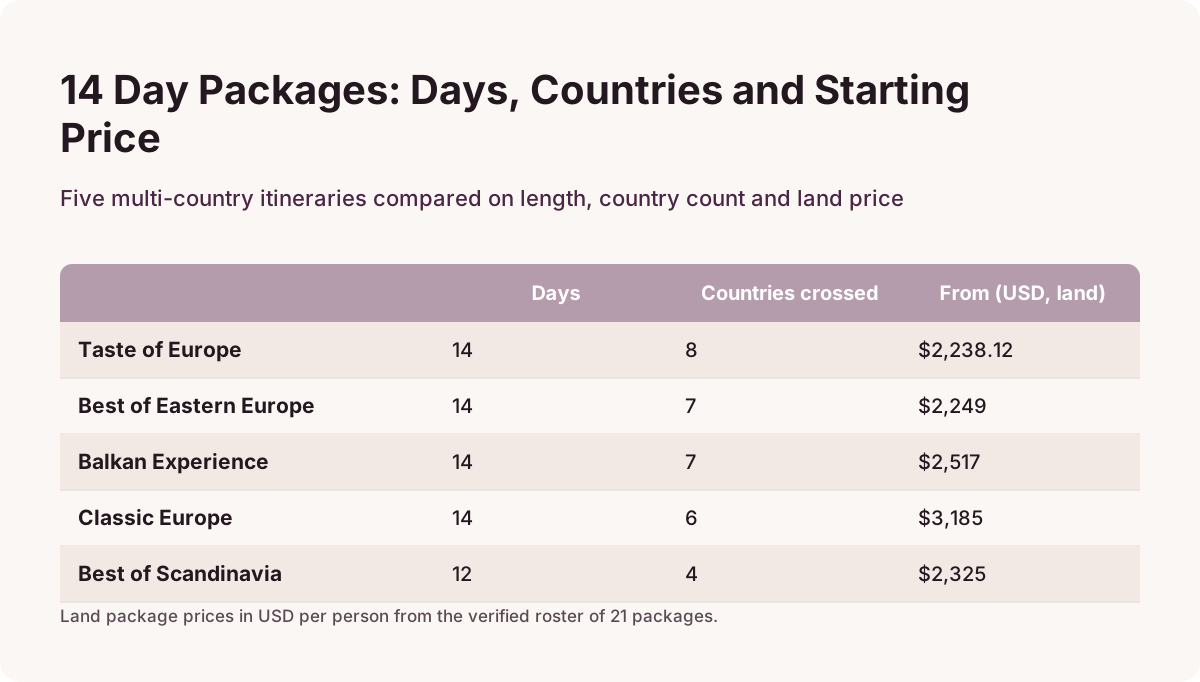
The widest country coverage on the roster belongs to Europe Jewel and Balkan Explorer, each crossing 10 countries in 14 days from Paris, and it is matched by other ten-country designs in different regions. The Best of Eastern Europe trip covers 5 countries in 14 days from $2,249 per person, and the Balkan Experience route strings 7 countries across its 14 days from $2,517 per person.
Breadth is not confined to one region. The roster splits into five families: 8 western Europe classics, 5 Balkans and Adriatic trips, 3 central and eastern Europe packages, 3 Scandinavia and Baltics trips, and 2 Britain and Ireland tours. Each family has its own answer to the split question, because the geography sets the driving legs.
| Package | Days | Countries crossed | From (USD, land) | Rating |
|---|---|---|---|---|
| Taste of Europe | 14 | 8 | $2,238.12 | 4.0 across 17 reviews |
| Best of Eastern Europe | 14 | 7 | $2,249 | 4.4 across 58 reviews |
| Balkan Experience | 14 | 7 | $2,517 | 4.5 across 41 reviews |
| Classic Europe | 14 | 6 | $3,185 | 4.6 across 309 reviews |
| Best of Scandinavia | 12 | 3 | $2,325 | 4.9 across 118 reviews |
The Taste of Europe itinerary is the roster's breadth benchmark: France, Italy, Monaco, Switzerland, Germany and more, in the operator's own official title, across 14 days from Paris. It carries a 4.0 rating across 17 reviews, which is an honest, modest pool, and it is a low-cost 14 day option at $2,238.12 per person for the land package. The price is low precisely because the design is dense: many border crossings, many one-night stops, and a pace that suits travellers who want the map ticked rather than unpacked.
By contrast, the 15-day Best of Central Europe package runs from $4,025 and covers 15 destinations in the premium tier, trading country count for depth of stay. Neither design is better in the abstract; they answer different versions of the two week question. A reader deciding between them is really deciding whether the fourteenth day should be a new country or a second night somewhere already visited, and our 10 day vs 14 day vs 21 day comparison works through that choice in detail.
One caution about reading country counts off any listing: a stop appears in this site's data only where the listing confirms it. Conditional stops, the ones a tour reaches only if time or weather allows, are recorded as options, not promises. When you compare two itineraries, check which stops are confirmed and which are flagged as optional, because a nine-country headline with two optional stops can be a seven-country trip in practice.

How Many Countries Should You Actually Aim For?
Most travellers on a two week first trip to Europe are better served by 5 to 7 countries with at least two nights in the anchor cities than by 8 to 10 single-night stops. The roster supports both designs, but the review data leans one way: the most-reviewed product on the site, Europe Escape with 878 reviews, runs 12 days and a moderate country count, and it outsells every high-count itinerary by reader engagement.
The argument for restraint is not sentiment, it is how days convert into memories. A two-night stop gives you an evening, and the evening is when a European city reveals itself: the dinner hour, the walk after dinner, the square at dusk. A one-night stop gives you a hotel on the outskirts, a morning departure and a view of the ring road. Travellers who report tour fatigue almost always describe the second kind of day repeated five times.
The counter-argument is real, though. Some travellers have one two week window in Europe in their entire lives, and for them a single night in Munich is the only Munich they will ever have. The high-count designs exist for exactly that reader, and the honest advice is to know which one you are before you book. The blog post on what the best 14 day itinerary for Europe looks like frames the same choice from the itinerary side.
There is also a border-rules dimension to country count that almost nobody plans for. The Schengen area is 29 countries, but several countries common on these routes are outside it: the United Kingdom, Ireland, Serbia, Bosnia and Herzegovina, Montenegro, Albania, North Macedonia and Kosovo. A Balkans loop that dips in and out of Croatia crosses an external Schengen border more than once, which means EU border registration can happen more than once on a single trip. The European Commission's own list of Schengen countries is the reference for checking which legs of a route cross which borders.
How Does The Region Change The Split?
The same fourteen days buy different country counts depending on region: in western Europe the classic corridor often covers 8 to 9 countries in 14 days, in the Balkans the same window yields 7 because the countries are smaller and closer together, and in Scandinavia it yields 3 to 4 because the distances are vast and the ferries are slow. The roster's five region families each encode this geography.
The Balkans are the roster's efficiency champion for pure counting. Serbia, Bulgaria, North Macedonia, Albania, Montenegro, Croatia and Bosnia and Herzegovina sit close enough together that a 14 day loop from Belgrade crosses all seven, from $2,517 per person on the Balkan Experience route, rated 4.5 across 41 reviews. The 16 day Balkan Explorer from Athens stretches to $2,665 and adds Greece to the count. These are also the itineraries where the non-Schengen border crossings stack up, so the passport gets more of a workout per day than anywhere else on the roster.
Scandinavia runs the opposite arithmetic. The Best of Scandinavia summer trip covers 4 countries in 12 days and costs from $2,325, rated 4.9 across 118 reviews, one of the deeper review pools on the site. The premium Scenic Scandinavia and its Fjords product spends 14 days on fjord country at from $5,265, the most expensive package on the roster, and buys almost no extra country count at all: it buys landscape and boat time. The Baltic States and Scandinavia route adds the three Baltics to reach a broader count in 14 days from $3,259.
| Region family | Packages | Typical country count in 12-16 days | Price span (land, per person) |
|---|---|---|---|
| Western Europe classics | 8 | 5 to 8 | $2,110 to $5,085 |
| Balkans and Adriatic | 5 | 6 to 8 | $2,517 to $5,242 |
| Central and Eastern Europe | 3 | 4 to 7 | $2,249 to $4,025 |
| Scandinavia and Baltics | 3 | 3 to 6 | $2,325 to $5,265 |
| Britain and Ireland | 2 | 2 to 3 | $3,235 to $5,049 |
Britain and Ireland are the narrow end, and deliberately so. The 13 day Best of UK and Ireland trip covers 2 countries from $3,235, rated 4.7 across 449 reviews, one of the strongest combinations of rating depth and value on the site. Celtic Highlights, its premium sibling, covers the same two countries in 13 days from $5,049 with a 5.0 rating across 384 reviews. These are the products that prove the count is a design choice, not a hierarchy: two countries, thirteen days, and a following that dwarfs most of the high-count routes.
What Do The Day Splits Look Like On Real Itineraries?
On the roster's 14 day itineraries, a typical split gives the gateway city 2 to 3 nights, distributes 1 night each across most en-route countries, and reserves the final night for the departure city, which means roughly a third of the trip's nights sit in just two cities. The pattern repeats across the western classics because the corridor is the same: London or Amsterdam in, Paris or Rome out.
Eight of the 21 packages start and finish in the same city, which produces a loop design: the coach radiates out and returns, and the traveller books one pair of flights. The rest are point-to-point, which suits travellers who want to extend independently at the far end. The Taste of Europe route runs Paris round trip; Classic Europe runs London round trip; Europe Jewel runs Amsterdam round trip. The point-to-point products, like European Whirl ending in Paris, trade the return drive for a second hub city.
The roster's departure calendars shape when each split is even possible. September is the busiest month, offered by 14 of the 21 products, followed by May on 14 and June on 12. April appears on 13, October on 10, July on 6, March on 6, August on 3, December on 3, November on 2, and January on 1. February appears on none of the 21 departure calendars, which is a calendar fact rather than a climate claim, but it does mean a February traveller is choosing from a much smaller shelf. Our guide to the best time of year for a 14 day Europe tour works through the calendar in full.
Pacing also interacts with entry rules in a way worth flagging once. A 12 to 16 day tour uses only a small fraction of the Schengen allowance of 90 days in any 180-day period, so the count of countries is never a visa problem for US, Canadian, Australian or British passport holders on a short stay. The official EU ETIAS site confirms those travellers need no visa now, and the future ETIAS authorisation is not yet in operation, with the EU expecting it in the last quarter of 2026. Anyone planning a trip around a high country count should watch that timeline rather than assume anything is required today.
Which Split Suits Which Traveller?
Choose a high-count split of 7 to 8 countries if this is a once-in-a-lifetime sweep and you accept one-night stops; choose 4 to 6 countries with two-night anchors if you want evenings in the big cities; choose 2 to 3 countries if the trip is about depth, scenery or family pace. The roster supports all three, and the price difference between them is smaller than most travellers expect.
The budget end of the roster is where the high-count designs live, and that is not a coincidence. Dense itineraries with larger joined groups are the cheapest way to move a traveller across Europe: the Madrid-departure 14 day coach trip runs from $2,110.29 per person and carries no rating yet because it is genuinely new. The Best of Eastern Europe, 7 countries from $2,249, rated 4.4 across 58 reviews, sits in the same band. Ten of the 21 packages cost between $150 and $230 per person per day, and almost all of those are the breadth products.
The mid-count designs are the roster's centre of gravity. Europe Jewel, 14 days from Amsterdam from $2,835 and rated 4.5 across 405 reviews, is the classic corridor at a mid price. Classic Europe, 14 days from London from $3,185 and rated 4.6 across 309 reviews, is its round-trip sibling. These carry some of the deeper review pools on the site, which tells you where two week travellers actually land: not at the extremes, but at the route that gives Paris and Rome real time while still crossing six countries.
The depth designs cost more per country but less per memory. The premium alpine Country Roads of Bavaria, Switzerland and Austria trip runs 12 days from $5,085, rated 4.1 across 4 reviews, a small pool stated plainly. The small group Balkan products, like the Budapest to Dubrovnik extended route at from $4,957 rated 4.9 across 14 reviews, buy intimacy rather than count. If you are weighing that trade, the guide to Europe small group tours covers what the premium actually buys.
One last planning note that applies to every split: none of the 21 packages advertises free cancellation, and deposit and cancellation terms are the operator's own, sitting in that operator's booking conditions. A high-count itinerary with many fixed hotel nights is harder to change after booking than a loop with a single hub, so the split you choose also sets how flexible your money is. Read the booking conditions before the itinerary, not after.
If breadth is the goal, the three packages below span the honest options: the eight-country benchmark, the classic six-country corridor, and the compact northern alternative.
Common Questions About How 14 Days Split Across Europe Countries
How Many European Countries Can You Visit In 2 Weeks?
Eight countries is a realistic and verified maximum for a two week package: five of the 21 trips on this site cross exactly 8, and the widest itineraries reach 10 when they include micro-stops. Most first-time travellers are better served by 5 to 7 countries with two nights in each anchor city.
Is 8 Countries In 14 Days Too Rushed?
It is rushed by design, and for some travellers that is the point. Expect one-night stops in most en-route countries and two to three nights in the gateway cities. Travellers who want evenings in every major city should choose a 5 to 6 country itinerary instead.
Which Tour On This Site Covers The Most Countries?
The Taste of Europe route crosses 8 countries in 14 days from Paris, from $2,238.12 per person for the land package, rated 4.0 across 17 reviews. The Balkan Experience and Best of Eastern Europe routes cover 7 countries each in 14 days.
Do More Countries Cost More Money?
Not on this roster. The high-count products are mostly at the budget end, from $2,110 to $2,517 per person, because dense coach itineraries with joined groups are cheap to run. The premium products cover fewer countries and charge up to $5,265 for depth, scenery and small groups instead.
Does Visiting More Countries Affect Visa Rules?
For US, Canadian, Australian and British passport holders, no visa is needed for a short stay, and a 12 to 16 day tour uses only a fraction of the Schengen 90-day allowance. The main effect of a high count is more border crossings, and Balkans routes cross external Schengen borders repeatedly because Serbia, Bosnia, Montenegro, Albania and North Macedonia are outside the area.
Round Trip Or Point To Point: Which Split Is Better?
Eight of the 21 packages start and finish in the same city, which means one pair of flights and a loop route. Point-to-point products like European Whirl, which ends in Paris, trade the return drive for a second hub. Neither is better; the loop suits simple flight planning, the point-to-point suits an independent extension.