Do Americans Need ETIAS In 2026?
A clear, fact-checked answer for US travelers planning a 14-day Europe tour package, covering ETIAS timing, EES, passport rules, and how they affect bookings.


Do Americans Need ETIAS In 2026?
ETIAS is not yet in operation and no applications are being collected. The European Union expects the system to launch in the last quarter of 2026, and when it does, US passport holders will need an approved ETIAS travel authorisation before boarding a flight to any of the 30 countries that require it. For a multi-country Europe tour booked now, whether the trip date will fall after the launch is still uncertain.
The European Travel Information and Authorisation System has been in the works for years, and its timeline has shifted more than once. On 5 March 2025, EU Home Affairs Ministers endorsed a revised schedule: the Entry/Exit System would go live first in October 2025, and ETIAS would follow in the last quarter of 2026. The EES is now fully operational, but ETIAS is still not accepting applications. The EU’s own website states plainly that “no applications for travel authorisations are collected at this point” and that the specific launch date “will be announced later by the European Commission.”
For a US traveler holding a 14-day tour package booked for late 2026, the timing matters. If the tour departs before the ETIAS start date, no authorisation is needed. If it departs after, an ETIAS will be required, and the traveler must apply through the single official channel at europa.eu/etias. The fee is EUR 20, and the authorisation is linked to the passport used in the application. It is valid for up to three years or until that passport expires, whichever comes first.
The 30 countries that will require ETIAS are the 29 Schengen states plus Cyprus. Any of the multi-country itineraries on this site that cross France, Italy, Germany, Switzerland, the Netherlands or Austria will sit inside that zone. A traveler who books a tour like the Europe Jewel, a 14-day Amsterdam round trip that reaches ten countries, all of them inside the Schengen area, will need an ETIAS if the system is live on the departure date. The operator’s own booking conditions do not override the entry rule, so the responsibility sits with the traveler.
The EU has also set out a transitional period of at least six months once ETIAS launches. During that window, travelers should apply, but those without an authorisation will not be refused entry as long as they meet all other conditions. After the transitional period, a grace period of at least another six months follows, during which an ETIAS is required except for a first-time arrival since the end of the transition. That means a US traveler on a first Europe trip might still enter without one for a short while, but relying on that narrow exception is risky. The safe advice is to apply once the system opens.
What Is ETIAS And When Does It Start?
ETIAS is a travel authorisation, not a visa, and it will be required for nationals of 59 visa-exempt countries and territories, including the United States, to enter any of 30 European countries for a short stay of up to 90 days within a 180-day period. The European Union states that the system is expected to become operational in the last quarter of 2026, and the exact date will be announced several months before launch.
The distinction between an authorisation and a visa is important. A visa application requires an in-person appointment, supporting documents, and a fee that can run well over a hundred dollars. ETIAS is an online application that the EU expects to process within minutes for most travelers, though it can take up to four days, and in rare cases up to 30 days if additional checks are needed. The fee is EUR 20, and the authorisation is linked electronically to the passport number entered in the application. If the passport expires before the three-year validity is up, the authorisation expires with it.
The official ETIAS website is the only place to apply. The EU warns explicitly about copycat sites that charge extra fees on top of the EUR 20. A US traveler should bookmark europa.eu/etias and ignore any other service that offers to process the application for a higher price. The EU’s FAQ page states that “any additional fee charged on top of that goes to the intermediary services provider,” and the authorisation will be valid regardless of which channel it was obtained through, but the extra cost is avoidable.
The 30 countries that will require ETIAS are the 29 Schengen members: Austria, Belgium, Bulgaria, Croatia, Czechia, Denmark, Estonia, Finland, France, Germany, Greece, Hungary, Iceland, Italy, Latvia, Liechtenstein, Lithuania, Luxembourg, Malta, Netherlands, Norway, Poland, Portugal, Romania, Slovakia, Slovenia, Spain, Sweden, and Switzerland, plus Cyprus. A traveler on a tour that only visits non-Schengen countries like the United Kingdom, Ireland, Serbia, Bosnia and Herzegovina, or Albania will not need ETIAS for those legs, but any stop inside the Schengen area triggers the requirement.
For a US traveler holding a booking on one of the 21 multi-country packages listed on 14 Days Europe Tour Packages, the most common scenario is a tour that crosses several Schengen countries. The Europe Jewel, for example, starts and ends in Amsterdam and visits Germany, Czechia, Austria, Italy, Switzerland, France, Hungary, the Netherlands, Slovakia and Slovenia. Every one of those countries is inside the Schengen area, so an ETIAS will be mandatory once the system is live.
The EU has designed ETIAS to be valid for multiple entries. A traveler can enter and leave the Schengen area as often as the 90/180-day rule allows, using the same authorisation, as long as the passport remains the same. That means a single EUR 20 application covers several trips over up to three years, which is useful for a traveler who might return for another tour or a separate visit.
Do Americans Need A Visa For Europe In 2026?
No, US passport holders do not need a visa for a short stay of up to 90 days in any 180-day period in the Schengen area. The United States is listed in Annex II of the EU’s visa regulation as a visa-exempt country, and that status has not changed. ETIAS, when it starts, is an additional travel authorisation, not a visa, and it does not replace the visa exemption.
The legal basis is Regulation (EU) 2018/1806, which lists the countries whose nationals are exempt from the visa requirement for stays of no more than 90 days within any 180-day period. The United States appears in Annex II, alongside Canada, Australia, the United Kingdom, and dozens of other countries. The same regulation has been amended multiple times, and the consolidated text as of late 2025 confirms the exemption remains in force.
The practical consequence for a US traveler booking a 14-day tour is that the only electronic requirement on the horizon is ETIAS, not a visa. The 90/180-day rule is a rolling window: every day of presence in the Schengen area is counted against the 90-day allowance, looking back 180 days from that day. A 14-day tour uses 14 of those 90 days, leaving plenty of allowance for any other Schengen travel in the same window. The rule is not a per-trip limit; it is a continuous calculation, and a short tour sits comfortably inside it.
US travelers who have already spent time in Schengen countries earlier in the same 180-day period should do the arithmetic before booking. The UK Foreign, Commonwealth and Development Office warns that “visits to Schengen countries in the 180 days before you travel count towards your 90 days,” and the same rolling count applies to US passport holders. Overstaying the 90-day limit can lead to a ban of up to three years from entering Schengen countries, according to the FCDO.
The US Department of State’s own guidance, archived from July 2026, tells US citizens that “with a valid U.S. passport, you can stay up to 90 days during any 180-day period” and confirms that “U.S. citizen travelers do not need to get an Electronic Travel Authorization” as of that date. The same page notes that the EU is developing ETIAS and plans to launch it in late 2026. The State Department also advises that travelers “must wait an extra 90 days before applying to re-enter the Schengen area,” which is a simplified version of the rolling-window rule, though the legal text is more precise.
How Does The Entry/Exit System Affect US Travelers?
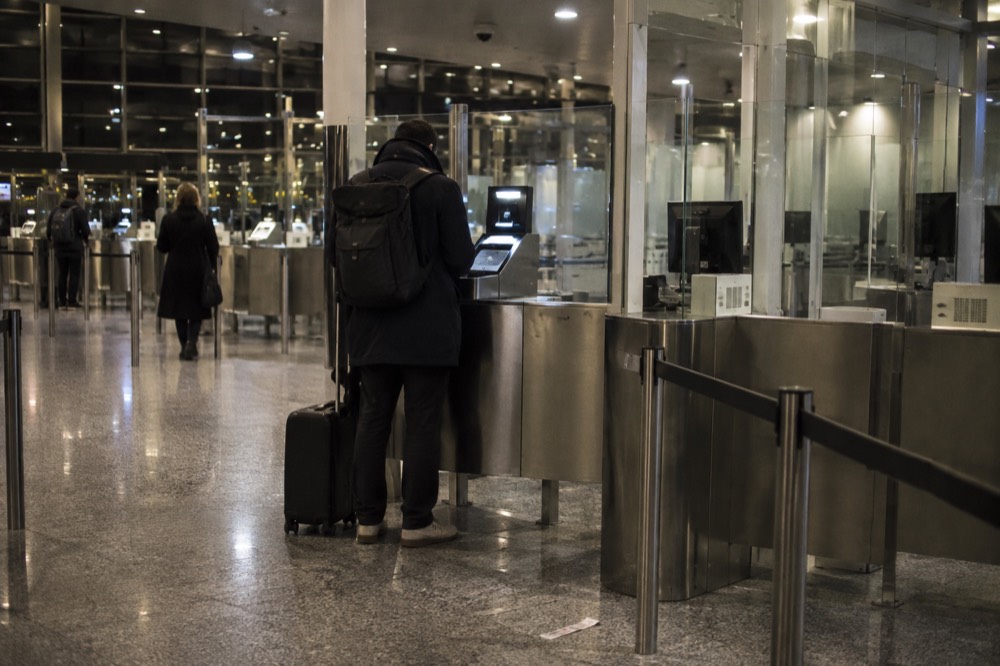
The Entry/Exit System has been fully operational at all external Schengen border crossing points since 10 April 2026, and it replaces manual passport stamping with digital registration of entry and exit dates, a facial image, and fingerprints. US travelers are already subject to EES registration on every entry and exit, and the system does not change the 90/180-day rule itself.
EES started on 12 October 2025 and phased in over six months. Since 10 April 2026, every non-EU traveler crossing an external Schengen border has been registered digitally. On the first crossing, the border officer scans the passport, takes a facial photo, and collects fingerprints. On subsequent crossings, the system verifies the stored biometrics, which the EU says is faster. The digital record is valid for three years and is shared across all EES countries, so a traveler who enters through Amsterdam and exits through Rome is tracked in one system.
For a US traveler on a multi-country coach tour, EES registration can happen more than once on a single trip. A Balkans itinerary that dips in and out of Croatia, for example, crosses an external Schengen border each time it leaves and re-enters the Schengen area. The same applies to a tour that includes a non-Schengen stop like the United Kingdom or Serbia between Schengen legs. Each crossing triggers a new EES registration, though the biometric data is already in the system after the first one.
The UK FCDO advises travelers to “be prepared to wait longer than usual at the border” because of EES, though no official processing-time figure exists. The EU’s own FAQ states that the process is quicker after the first registration. The US State Department’s archived page tells US citizens that “your fingerprints, facial image, passport details, and entry and exit dates will be collected upon entry to an EES country and stored digitally,” and confirms there is no fee for EES registration.
The 90/180-day rule is now enforced by the EES automated calculator. Overstays are flagged automatically, and the system can generate a list of overstayers. The manual passport stamp that once served as the only record of entry and exit dates is gone, so the digital record is the sole evidence of compliance. A traveler who loses track of days in the Schengen area no longer has a stamp to check, which makes the rolling-window calculation more important than ever.
What Passport Rules Apply To Americans Traveling To Europe?
Schengen law requires that a US passport be valid for at least three months after the intended departure date from the Schengen area and have been issued within the previous ten years. Several tour operators impose a stricter six-month rule, and a traveler who meets the Schengen minimum can still be denied boarding by the operator.
The Schengen Borders Code, Article 6, sets two conditions for the travel document: it must be valid for at least three months beyond the planned exit date, and it must have been issued within the previous ten years. Both are grounds for refusal at the border, and the ten-year rule catches US passports that were renewed early and carry an issue date more than a decade before the travel date. The UK FCDO provides the clearest warning on this point, noting that a passport renewed before 1 October 2018 might have an issue date more than ten years old and would be invalid for Schengen entry even if the expiry date is years away.
The US State Department’s archived guidance tells US citizens that their passport “must be valid for at least 3 months beyond your planned departure from the EU” and that it should be “valid for your entire stay plus an additional 3 months.” The State Department page does not mention the ten-year issue-date rule, but the Schengen legal text does, and border officers apply it.
Tour operators often set a stricter standard. Contiki’s booking conditions, updated August 2026, require a machine-readable passport valid for six months after the trip return date. Intrepid Travel’s US Standard Booking Conditions state the same six-month rule. Expat Explore does not set its own validity number and instead puts the duty on the traveler to check the requirements. A US traveler booked on a Contiki or Intrepid tour must have six months of passport validity beyond the return date, even though Schengen law only asks for three. The difference is contractual, not legal, but the operator can refuse boarding if the passport does not meet its own rule.
| Requirement | Schengen law (legal minimum) | Contiki (contractual) | Intrepid (contractual) |
|---|---|---|---|
| Passport validity beyond departure | 3 months after intended exit | 6 months after trip return | 6 months after last travel date |
| Issue date within last 10 years | Yes | Not stated separately | Not stated separately |
| Machine-readable passport | Not a Schengen requirement | Required | Not stated |
| Who enforces it | Border officer | Tour operator at check-in | Tour leader on day one |
The safe advice for a US traveler holding any 14-day tour package is to renew the passport if it will have less than six months of validity on the return date. That satisfies both the Schengen legal minimum and the stricter operator rules, and it avoids the ten-year issue-date trap. The official ETIAS website also warns that an ETIAS authorisation is linked to the passport used in the application, so a passport renewal after obtaining ETIAS means applying again and paying another EUR 20. For a more detailed look at passport rules, see our guide on passport validity rules for Europe tours.
What About The UK ETA For A Europe Tour That Starts In London?
A US traveler whose 14-day Europe tour includes a stop in the United Kingdom needs a UK Electronic Travel Authorisation, which is separate from ETIAS and already in force. The ETA costs £20, is required for every traveler including children, and does not guarantee entry.
The UK ETA is not a Schengen or EU requirement. It is a UK entry requirement that applies to US passport holders arriving for a visit of up to six months, including those who are only transiting through UK border control on the way to a connecting flight. The UK Home Office states that each person traveling needs an ETA, including babies and children, and that British and Irish passport holders do not need one.
A 14-day tour that begins in London, such as the Classic Europe itinerary that starts and ends in the British capital, requires both a UK ETA for the London leg and an ETIAS once the system is live for the Schengen countries visited after crossing the Channel. The two authorisations are applied for on separate government websites, cost different amounts, and have different validity periods. The UK ETA is linked to the passport and allows multiple entries over its validity, though the UK government does not state a fixed validity period on its main guidance pages; only the per-visit maximum of six months is stated.
The UK ETA application is online and the fee is £20. The UK government advises travelers to apply before booking travel, and the decision is usually quick. A traveler who arrives at a UK airport without an ETA can be denied boarding by the airline. For a US traveler on a tour that includes both the UK and Schengen countries, the checklist is: a valid passport meeting both the Schengen and operator rules, a UK ETA, and an ETIAS if the system is live on the departure date.
What Travel Insurance Do Americans Need For A Europe Tour?
Travel insurance is not a legal Schengen entry condition for US passport holders, but several tour operators make it a mandatory condition of joining the trip. Intrepid Travel and G Adventures require it, Expat Explore makes it a condition of booking, and Contiki only recommends it. A US traveler should check the operator’s contract before departure.
The Schengen Borders Code lists five entry conditions for a short stay, and insurance is not among them. The requirement to hold medical travel insurance applies to Schengen visa applicants, not to visa-exempt visitors like US passport holders. The EU’s own ETIAS and EES websites make no mention of insurance. However, individual border officers in France and Italy may ask to see proof of travel insurance, according to the UK FCDO, so carrying a policy is still sensible even where it is not legally mandated.
The operator’s contract is where the requirement becomes binding. Intrepid Travel’s US Standard Booking Conditions state that travel insurance is mandatory and must cover personal accident, death, medical expenses, and emergency repatriation with a recommended minimum of US$200,000 per category. The policy number and the insurer’s 24-hour emergency number must be provided on day one, or the traveler cannot join the tour. G Adventures also requires medical travel insurance with at least US$200,000 of emergency evacuation and repatriation cover, and the tour leader will ask for proof on day one. Expat Explore’s terms go further: adequate travel insurance is a condition of booking, and a traveler who cannot show proof before the tour starts will not be allowed to embark.
Contiki, by contrast, states in all four regional booking conditions dated August 2026 that travel insurance is “highly recommended” but not required. The wording is identical across the US, UK, EU, and Australian versions. The operator will not ask for proof and will not deny boarding for lack of insurance, though it also will not be liable for any costs a traveler incurs without it.
| Operator | Insurance requirement | Minimum coverage stated | Proof required |
|---|---|---|---|
| Intrepid Travel | Mandatory | US$200,000 recommended | Policy number and emergency contact on day one |
| G Adventures | Mandatory | US$200,000 emergency evacuation and repatriation | Proof on day one |
| Expat Explore | Condition of booking | Not stated as a dollar figure | Proof before tour start |
| Contiki | Recommended, not required | Not stated | Not requested |
A US traveler booking a tour operated by Intrepid, G Adventures, or Expat Explore should purchase an adequate travel insurance policy soon after booking and keep the policy documents accessible. A traveler on a Contiki tour can still choose to go without, but the financial risk of a medical emergency in Europe without coverage is substantial. The choice of insurer is the traveler’s own, and no operator on this site sells insurance directly. Read our full comparison of travel insurance requirements for escorted Europe tours.
How Does A 14-Day Tour Package Fit The Entry Rules?
A 14-day multi-country Europe tour uses 14 of the 90 Schengen days allowed in a rolling 180-day window, leaving ample room for other travel. The entry rules are the same regardless of how many countries the tour visits, and the key preparation steps are a valid passport, an ETIAS once live, and the operator’s own contractual requirements.
The 21 packages listed on this site range from 12 to 16 days, with 11 of them running exactly 14 days. The Europe Jewel, a 14-day Amsterdam round trip, crosses ten Schengen countries. The Classic Europe, a 14-day London round trip, adds the UK to the mix, which means a UK ETA is needed alongside the eventual ETIAS. The Central & Eastern Europe Explorer, a 15-day Munich round trip, stays entirely within the Schengen area and visits Germany, Czechia, Poland, Slovakia, Hungary, Austria, and Slovenia. Each tour’s country list determines which authorisations apply, but the core passport and insurance rules are the same across the board.
The practical timeline for a US traveler booking a tour for late 2026 is to secure the passport first, then apply for the UK ETA if the itinerary touches the UK, and monitor the ETIAS launch announcement. The EU has said it will give several months’ notice before ETIAS goes live, so a traveler who books now will have time to apply once the system opens. The transitional period of at least six months after launch means that even if the tour date falls just after the start, the traveler may still be able to enter without an ETIAS, but relying on that is unnecessary when the application costs EUR 20 and takes minutes.
The operator’s own rules sit on top of the government requirements. A traveler on a Contiki tour needs a passport valid for six months after return and is recommended to have insurance. A traveler on an Intrepid tour needs the same passport validity and mandatory insurance. The differences are small but real, and they are spelled out in the booking conditions that every traveler agrees to at checkout. Reading those conditions before paying the deposit avoids a surprise at the airport.
The Europe Jewel tour is a useful benchmark because it covers ten Schengen countries from a single starting point, and its Amsterdam round-trip format means the traveler enters and exits the Schengen area at the same airport. The EES registration will happen on arrival at Schiphol and again on departure, and the ETIAS, once live, will be checked by the airline before boarding the outbound flight. The tour itself handles the internal border crossings, which are inside the Schengen area and do not involve passport checks, so the traveler only deals with the entry formalities once per trip.
The Classic Europe tour adds a London start and finish, which means the traveler clears UK border control on arrival and again on departure after the tour returns from the Continent. The UK ETA is required for both entries, and the ETIAS will be required for the Schengen portion once live. The combination of two electronic authorisations and two different border systems is more paperwork than a Schengen-only tour, but it is manageable with advance planning.
Common Questions About ETIAS And US Travelers To Europe
Do Americans Need ETIAS In 2026?
ETIAS is not yet in operation, and no applications are being collected. The EU expects the system to launch in the last quarter of 2026. Once live, US passport holders will need an approved ETIAS before traveling to any of the 30 European countries that require it. Until the launch date is announced, no action is needed.
When Will ETIAS Start For Americans?
The European Commission has stated that ETIAS is expected in the last quarter of 2026, and the specific date will be announced several months before launch. No day or month has been published. The system has already been delayed once, so a traveler should check the official site at europa.eu/etias for updates.
How Much Does ETIAS Cost For US Citizens?
The ETIAS application fee is EUR 20. Applicants under 18 or over 70 are exempt from the fee, as are qualifying family members of EU, EEA, or Swiss nationals. The fee is non-refundable, and there is only one official application website.
Do Americans Need A Visa For Europe?
No. US passport holders are visa-exempt for short stays of up to 90 days in any 180-day period under EU Regulation 2018/1806. ETIAS is a travel authorisation, not a visa, and does not change the visa exemption.
What Is The EES And Does It Affect US Travelers?
The Entry/Exit System has been fully operational since 10 April 2026. It digitally registers the entry and exit of non-EU travelers at Schengen external borders, collecting a facial image and fingerprints. US travelers are subject to EES on every crossing, and manual passport stamping has been abolished.
Does A US Traveler Need A UK ETA For A Europe Tour?
If the tour includes a stop in the United Kingdom, a UK Electronic Travel Authorisation is required. The ETA costs £20 and is needed by every traveler, including children, even for transit through UK border control. It is separate from ETIAS and already in force.