How To Build A 2 Week Europe Itinerary That Actually Works
Two weeks is enough for a genuinely satisfying Europe trip, but only if the route is honest about travel time. Here is how the geography, the pacing and the price actually work.
Short answer
Across the 21 packages on this site, 11 run exactly 14 days and prices span $2,110 to $5,265 per person, land only, with a median of $3,235. The widest itineraries cross 10 countries, but five of the 21 stick to 8. Flights are never in the price, and no tour on the roster offers free cancellation.
How To Build A 2 Week Europe Itinerary That Actually Works
Two weeks is the sweet spot for a first Europe trip: long enough to reach four or five genuinely different countries, short enough that you are not living out of a suitcase for a month. The catch is that the map lies. A route that looks tidy on paper can spend half its days on motorways, and a route that looks ambitious can actually be calm if the night counts are right. This guide works through the real arithmetic of a 2 week Europe itinerary using the verified numbers from the 21 packages collected on 14 Days Europe Tour Packages, so every figure here comes from an actual bookable listing rather than a guess.
What Does A Realistic 2 Week Europe Itinerary Look Like?
A realistic two week route covers five to eight countries with one or two nights in most stops, runs point to point or as a single loop, and stays inside one region rather than crossing the whole continent. Country counts across the 21 packages on this site run from 2 at the narrowest to 10 at the widest, and five of the 21 cross exactly 8 countries, which is the practical ceiling for a comfortable trip.
The single most common planning mistake is treating Europe as one blob. It is not. The 21 itineraries on this site split into five distinct regions: 8 are Western Europe classics, 5 cover the Balkans and the Adriatic, 3 run Central and Eastern Europe, 3 cover Scandinavia and the Baltics, and 2 cover Britain and Ireland. A route that mixes two of those regions in one fortnight is possible, but every hour spent crossing between them is an hour not spent anywhere.
The second mistake is underestimating how much of a 14 day trip is transit. A coach itinerary that visits eight cities in 14 days is really giving you roughly a day and a half per city, minus the driving. That can still be a great trip if you want breadth over depth, and the packaged itineraries are built exactly for that traveller. The listings that work best are the ones where the night counts are printed openly, so you can see before booking that a stop is a drive-through lunch rather than a stay.
Which Countries Should Two Weeks In Europe Cover?
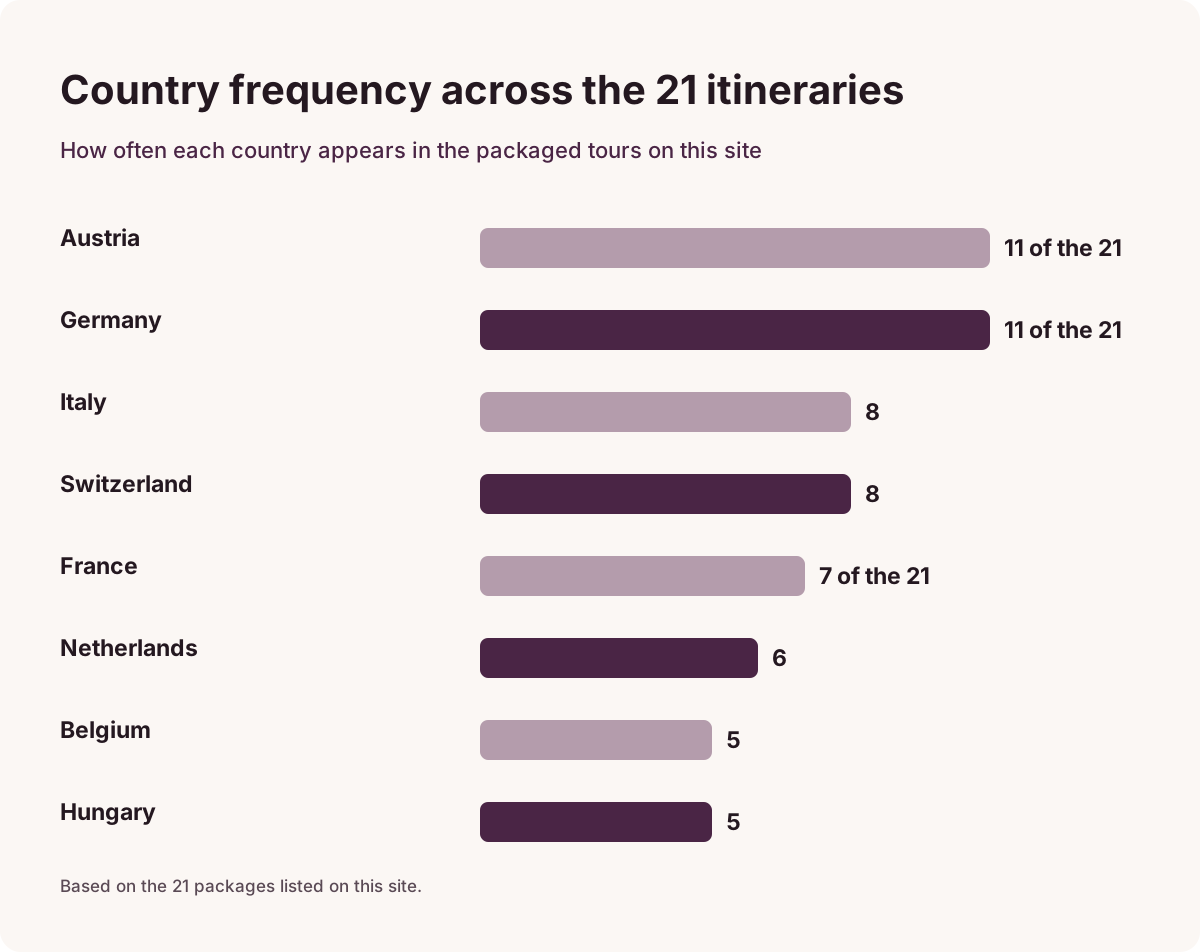
For a first trip, the verified answer is a Western Europe loop through France, Italy, Switzerland and the Alpine neighbours: Austria appears in 11 of the 21 itineraries, Germany in 11, Italy in 8 and Switzerland in 8, making that cluster the best-served geography on the whole roster. For a second trip, the Balkans and Central Europe itineraries reach places the classic routes skip, at lower prices.
The country-frequency numbers are worth reading closely because they tell you where the packaged-tour industry has already solved the logistics. France appears in 7 of the 21 itineraries, the Netherlands in 6, Belgium in 5, Hungary in 5 and Serbia in 5. Those are the corridors with the motorways, the border crossings and the hotel capacity that a coach full of travellers needs. When an itinerary reaches a country that appears on none or few of the rosters, it usually means the operator runs a smaller vehicle there, which is worth checking against the listing.
The Balkans are the clearest value case on the site. The Balkan Experience itinerary, official title "Balkan Experience: Serbia, Bulgaria, North Macedonia, Albania, Montenegro, Croatia & Bosnia and Herzegovina, 14 Days", runs from $2,517 per person for the land package and carries a 4.5 rating across 41 reviews. It reaches seven countries in a fortnight, several of which sit outside the Schengen area entirely, which changes the border arithmetic in a way the classic routes never do.
For readers weighing the trade-offs between a self-built rail route and a packaged one, the rail pass versus coach tour comparison covers the cost logic in detail, and the guide to how 14 days split across countries breaks the night-by-night arithmetic down further.
The three routes above represent the three most common answers to the two week question: the full classic loop, the shorter 12 day escape that trims the price to from $2,715 per person, and the premium Central Europe route that trades breadth for depth across 15 destinations.
How Do Packaged Itineraries Split 14 Days?
Packaged 14 day itineraries typically run point to point or as a single round trip, with 19 of the 21 packages on this site including all accommodation and internal transport in the headline price, and 19 including some meals, never all of them. Eight of the 21 start and finish in the same city, which saves you the cost and hassle of a second long-haul arrival airport.
The round trip versus one-way split matters more than most planners realise. A London round trip like Classic Europe, official title "Classic Europe", means one flight booking, one airport transfer pair and one customs line. A point-to-point route like European Whirl, which ends in Paris, means flying home from a different city, which can be cheaper on some fares and more expensive on others, and it means your luggage travels the whole route with you rather than meeting you at the end.
The Classic Europe itinerary is the archetype of the format: 14 days from London, a 4.6 rating across 309 reviews, from $3,185 per person for the land package, with some meals included. Group size is on the operator's listing rather than in a fixed number, which is true of every product on this site. It is the most-reviewed classic route after Europe Escape, and the depth of that review pool is itself information: 309 people have booked it, travelled it and rated it, which is a different evidence base from a route carrying a handful of reviews.
The day-splitting logic is worth borrowing even if you never book a package. The operators who run these routes for a living have converged on the same pattern: two or three nights in the marquee cities, single nights in the transit stops, and a longer pause somewhere scenic in the middle of the trip to break up the coach days. Any self-built route that ignores that rhythm tends to collapse by day ten.
What Does A 2 Week Europe Itinerary Cost?
Across the 21 packages on this site, land prices run from $2,110 to $5,265 per person, with a median of $3,235. Cost per day spans $151 at the cheapest end to $437 at the most expensive, and ten of the 21 sit between $150 and $230 a day. None of those prices includes international flights, which every operator on the roster lists as excluded.
The per-day figure is the honest way to compare routes of different lengths. Two packages can sit within a few hundred dollars of each other in total while delivering very different day counts, so dividing the headline price by the trip length tells you what a day of that route actually costs. The budget end of the roster is real: The Best of Eastern Europe runs 14 days from $2,249 per person with a 4.4 rating across 58 reviews, and the Madrid departure coach trip runs from $2,110.29, though it is genuinely new and carries no rating and no reviews yet, which is stated plainly rather than dressed up.
The premium end buys depth and smaller vehicles rather than better hotels alone. Best of Central Europe, official title "Best of Central Europe (15 destinations)", runs from $4,025 per person across 15 days, and the small-group Balkan options run higher still, from $4,957 for the Budapest to Dubrovnik extended route with a 4.9 rating across 14 reviews. The small-group premium is a genuine product difference, not a markup on the same trip: fewer travellers per vehicle, more flexibility in the stops.
| Package | Days | From (USD, per person, land) | Rating and reviews |
|---|---|---|---|
| Madrid departure coach trip | 14 | $2,110.29 | No rating yet |
| Taste of Europe, eight countries | 14 | $2,238.12 | 4.0 across 17 reviews |
| The Best of Eastern Europe | 14 | $2,249 | 4.4 across 58 reviews |
| Europe Escape | 12 | $2,715 | 4.5 across 878 reviews |
| Balkan Experience | 14 | $2,517 | 4.5 across 41 reviews |
| Classic Europe | 14 | $3,185 | 4.6 across 309 reviews |
| Best of Central Europe | 15 | $4,025 | 4.5 across 18 reviews |
| Scenic Scandinavia and its Fjords | 14 | $5,265 | 4.4 across 29 reviews |
The price column stops at the land package on purpose. The operators' own product pages list flights in the not-included block across the roster, and the Europe Escape page states in its own words that the price does not include international flights, so the long-haul ticket is always a separate cost you book yourself. No verified airfare figure exists anywhere in this site's research, and none will be invented here. The full cost breakdown guide works through what sits inside the headline price and what gets added later.
When Should You Travel On A Two Week Europe Route?
The departure calendars across the 21 packages peak in September and May, each appearing on 14 of them, followed by June on 12 and October on 10. February appears on none of the 21 calendars, and January carries just one departure, so the packaged-tour year effectively runs from March to December with a mid-winter gap.
Reading the calendar as a planning tool: April appears on 13 products, July on 6 and August on only 3, which tells you the operators themselves avoid the peak summer heat and crowds for the classic coach routes. If your only available window is July or August, your packaged options are roughly half of what they are in May or September, and the routes that do run then book earlier. November carries 2 departures and December 3, one of which is the Classic Europe Christmas & New Year departure at from $3,655 per person with a 5.0 rating across 17 reviews.
| Month | Products offering departures | Month | Products offering departures |
|---|---|---|---|
| January | 1 | July | 6 |
| February | 0 | August | 3 |
| March | 6 | September | 14 |
| April | 13 | October | 10 |
| May | 14 | November | 2 |
| June | 12 | December | 3 |
The seasonal shape of the roster also answers a question people rarely think to ask: winter two week routes exist, but they are a niche product. The Christmas departure is the only festive classic on the roster, and the Balkans winter options are limited to what each operator's calendar shows. For a deeper treatment of the trade-offs, the best time of year guide covers the same departure-month data month by month.
One caveat belongs here because it belongs nowhere else: no per-city temperature, rainfall or crowd figure is published anywhere in this site's research, so none appears in this guide. Seasonality here is read from the departure calendars, which is what the operators actually commit to running.
How Do You Choose Between The Main Route Styles?
Choose by region first and pace second: the Western classics give you the headline cities and the biggest review pools, the Balkans give you seven-country breadth at the lowest prices, Central and Eastern Europe gives you the strongest value per day, and the Scandinavia and Britain routes trade country count for scenery and depth.
The review-pool point deserves more weight than it usually gets. Europe Escape carries a 4.5 rating across 878 reviews, which is by far the deepest evidence base on the roster, and Best of UK & Ireland carries a 4.7 across 449. Those numbers mean the routes have been stress-tested by hundreds of travellers, and the rating has survived. By contrast, Central and Eastern Europe Explorer carries a 4.9 from only 7 reviews, and Country Roads of Bavaria, Switzerland & Austria carries a 4.1 from 4 reviews. Those are honest ratings from small pools, not verdicts, and the review count is always printed beside the rating on this site for exactly that reason.
The Balkans routes reward a traveller who has already done the classics or wants to skip them. The semi-private Athens to Sarajevo option runs with a maximum of 10 travellers, from $3,784 per person for 14 days, with a 5.0 rating across 22 reviews, and it is the only private-format departure on the entire roster: 20 of the 21 packages are joined group departures. The Small Group Balkan Essentials route runs from $5,242 for 12 days with a 4.8 across 27 reviews, the price of a genuinely small vehicle and a dedicated leader.
Central Europe is the value sleeper. The Best of Eastern Europe route covers the region in 14 days from $2,249 per person, and its 4.4 across 58 reviews makes it one of the better-evidenced budget routes on the site. Budapest, the Prague-adjacent corridors and the Vienna-adjacent stops deliver the old-world density that first-time visitors expect from Western routes, at roughly two-thirds of the classic-loop price.
If London is your natural arrival hub, the Europe Jewel route runs 14 days from Amsterdam as a round trip, from $2,835 per person with a 4.5 across 405 reviews, the second-deepest pool on the roster. It covers the same classic corridor as the London loop with a different start line, which matters if your long-haul flight is cheaper into Amsterdam.
| Route style | Roster count | Price span (from, per person) | Deepest review pool |
|---|---|---|---|
| Western Europe classics | 8 | $2,110.29 to $5,085 | Europe Escape, 878 reviews |
| Balkans and the Adriatic | 5 | $2,517 to $5,242 | Balkan Explorer, 46 reviews |
| Central and Eastern Europe | 3 | $2,249 to $4,025 | The Best of Eastern Europe, 58 reviews |
| Scandinavia and the Baltics | 3 | $2,325 to $5,265 | Best of Scandinavia, 118 reviews |
| Britain and Ireland | 2 | $3,235 to $5,049 | Best of UK & Ireland, 449 reviews |
What Should You Check Before Booking A Two Week Route?
Check four things against the operator's own listing before you commit: whether your passport meets both the legal and the operator's validity rules, whether your route crosses non-Schengen borders, what the insurance clause actually says, and what the cancellation terms are, because none of the 21 packages on this site advertises free cancellation.
The passport point catches people because two different rules apply. Schengen law requires a passport valid for at least three months after your intended departure from the area and issued within the previous ten years, per the Schengen Borders Code. But Contiki's booking conditions require a machine-readable passport valid for six months after the trip return date, and Intrepid's US standard booking conditions require six months after the last date of travel. Six months beyond your return date is the safe number that satisfies all of them.
The border point matters most on Balkans routes. Croatia, Bulgaria and Romania are all inside Schengen, but Serbia, Bosnia and Herzegovina, Montenegro, Albania and North Macedonia are not, so a Balkan loop crosses an external Schengen border more than once, and days in the non-Schengen countries do not consume your 90 day Schengen allowance. The EU's own Schengen area page carries the definitive country list. A 14 day tour uses a small fraction of the 90 days in any 180 regardless.
Insurance is a contractual question, not a legal one. Travel insurance is not a legal entry condition for visa-free visitors to Schengen, but Intrepid and G Adventures both make it mandatory with a US$200,000 minimum and proof on day one, Expat Explore makes it a condition of booking, and Contiki only recommends it, per each operator's own published terms. Read your specific operator's clause rather than assuming. The insurance requirements guide quotes all four positions side by side.
On cancellation: zero of the 21 packages advertise free cancellation. Deposit and cancellation terms sit in each operator's own booking conditions, and the deposits and booking windows guide explains how to read them before you pay anything. The UK's own border authority also notes that travellers may be asked at French or Italian border control to show proof of insurance, a return ticket and sufficient funds, per the FCDO's entry requirements page, which is a good reason to carry documents even when nothing is legally demanded.
Which Two Week Itinerary Suits Which Traveller?
A first-time visitor wanting the headline cities should take a classic loop such as Classic Europe or Europe Jewel, a value-focused traveller should look at Eastern Europe or the Madrid departure, a traveller who has done the classics should look at the Balkans, and a scenery-first traveller should pay the premium for the fjords or the Alpine country roads.
The honest summary of the whole roster is that there is no bad region, only bad fits. The classic loops from $2,835 to $3,804 per person are the default answer for a reason: they deliver the cities people fly across oceans for, with the logistics solved. The budget routes from $2,110 to $2,715 trade marquee names for breadth and still carry solid ratings. The premium routes from $4,957 to $5,265 buy small groups, fjords and alpine roads rather than more countries.
Two structural facts close the decision. First, every price on this site is a land price, so budget the long-haul flight separately and no verified airfare figure exists to quote here. Second, group size is on the operator's listing for 20 of the 21 products, and only the semi-private Athens to Sarajevo route publishes a verified cap of 10 travellers, so read the listing rather than assuming.
Common Questions About A 2 Week Europe Itinerary
How Many Countries Can You Realistically Visit In Two Weeks?
Across the 21 packages on this site, country counts run from 2 to 10, with five itineraries crossing exactly 8 countries. Eight is the practical ceiling for a comfortable 14 day trip, and the routes that hit it rely on short hops between neighbouring countries rather than long cross-continent drives.
What Does A 2 Week Europe Itinerary Cost?
Land prices across the roster run from $2,110 to $5,265 per person, with a median of $3,235. Cost per day spans $151 to $437, and ten of the 21 packages sit between $150 and $230 a day. International flights are excluded from every price, so the long-haul ticket is a separate cost.
Is A Package Better Than Building Your Own Route?
For a first trip, a package solves the two hardest problems, cross-border logistics and night-by-night pacing, and 19 of the 21 packages include all accommodation plus internal transport in the headline price. A self-built route wins on flexibility but demands you solve the transit arithmetic yourself.
Which Month Has The Most Departures?
September and May tie as the busiest months, each appearing on 14 of the 21 departure calendars, followed by June on 12 and October on 10. February appears on none of the calendars and January on only one, so the packaged year effectively runs March to December.
Do Any Of These Tours Include Flights?
No. Every price on this site is a land price. 19 of the 21 product pages list flights in their not-included block, and the other two products list no air either, so the long-haul ticket is always booked separately by the traveller.
Can You Cancel One Of These Packages For Free?
None of the 21 packages advertises free cancellation. Deposit and cancellation terms are set by each operator in their own booking conditions, so read those terms before paying a deposit rather than assuming a refund window exists.